


“What Domain Name Should I Use?”
Your domain name is an important part of your business’s online identity. It should be memorable, easy to communicate and suitable for the direction your business may take. Here are seven practical considerations when choosing a domain name.
Think of your website name like a person’s name. We create an association mentally between a person and their name. For example, if I say “Donald”, you think of firstly, a Donald that you may know and secondly, an emotion or characteristics of that person. The same can be said for a business name and a website name. In this blog, I will cover the key things I think are important when choosing the right domain name.
Your website naming or URL structure
For those with little to no knowledge of how domain names are set up, this part will help you structure your site URL so that anyone navigating your site can easily identify their location by simply looking at the URL. This only keeps it short and sweet as I will discuss later.
In the image seen here, we identify the different parts of the URL.
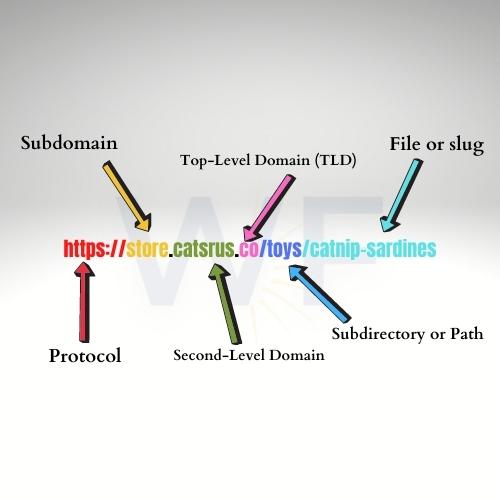
When you register a domain name, you obtain the right to use it for a specified registration period, subject to the registry’s rules. A domain typically consists of a chosen name and an extension, such as webforce.co.za.
A subdomain is an additional label before your domain, such as shop.example.co.za. It can help organise distinct sections or applications, but you do not need separate subdomains for a blog or store. A subdirectory may be simpler depending on your website structure.
Subdirectories are paths within a website, such as example.co.za/blog/. Unlike subdomains, they are not separate domain names and do not necessarily correspond to physical folders on a web server.
These options are available to you to consider depending on the scale of your website and the features needed.
Things to Consider
1. Which TLD to use?
Choose an extension that makes sense for your audience and brand. A .co.za domain is familiar to South African customers, while .com may suit a wider market. A domain extension alone does not guarantee stronger Google rankings, although location and branding can influence visitors’ expectations.
2. Throw in some Keywords
Relevant words can help people understand what a business offers, but you do not need to force keywords into your domain name for SEO. Prioritise a distinct, memorable brand that can grow with your services. If you need help with visibility after launch, explore our SEO services.
3. Accessibility and Spelling
The domain name should be unambiguous, easy to remember and spell. it makes it easier for someone to refer your website to someone else or recall when they need someone like you. Avoid tricky combinations like double letters (mmlounge.co.za or sscouriers.com) or similar characters like (10open.co, mnmicro.co.za). These make your site an easy target for typosquatting which is when someone reserves a domain similar to yours that prey on peoples typos to generate traffic.
Your name should also be as short as possible which encompasses the essence of your business. There is no fixed number that says it’s too long but you have to be reasonable. lucyshairandbeautysalon.com is much too long.
4. Avoid Hyphens and Numbers

This is not a hard and fast rule as there may be special use cases, like the demo sites created by Web Force here. Hyphens and numbers are hard to communicate or remember when typing or misspelt. When you tell someone “clubtwo”, they would ask “The number or the word two?”. It is a slight inconvenience you may not mind but to everyone else, the simplest frustrations could lead them to competitors. If your business name consists of numbers for whatever reason, then I suggest you purchase both, numbers and words, i.e. club2dance.com and clubtwodance.com and point them to the same website.
Remember to be creative with your name and NOT be creative in getting a name you want. Doing so may lead you to get the name in creative ways which are often harder for people to remember.
5. Maintain your Uniqueness
The domain name should consist of words or a short phrase that are unique to your business and the industry you serve. Be too generic and you lose your business identity.
6. Put in some Leg Work
Research similar names, spelling variations, social profiles and potential trademark conflicts before committing. Changing domains later is possible, but it requires careful redirects and updates to branding, email and search engine optimisation.
7. When should I look for a domain name?
As soon as you make the decision to create a website or contemplate registering your business, it’s the perfect time to start hunting for a domain name. Ideally, this process should run parallel to choosing a name. The sooner you dive into it, the wiser. If a domain name becomes unavailable, acquiring it later can be not only challenging but also come with a hefty price tag if at all possible.

Summary
As you may have noticed, all of these points need to be considered when choosing a domain name. There will be cases that you would go against it and that is okay. Just be sure to consider all the variables before you proceed.
If you’re planning a new website and would like help selecting a domain or getting started, contact Web Force or explore our website design options.